
Beyond Metal: How PEKK Is Redefining Orthopaedic Implant Design

Traditional orthopaedic implants have largely been built around metallic alloys for decades.
Titanium, cobalt chrome, and stainless steel transformed modern reconstruction and remain highly successful across many applications. But as orthopaedics evolves alongside advanced imaging, digital planning, additive manufacturing, and biologic understanding, the limitations of traditional metals are becoming increasingly relevant.
This is one of the reasons materials such as OsteoFab®️ PEKK are beginning to attract growing interest across upper limb surgery, oncology, revision reconstruction, and patient-specific implants.
The conversation is no longer simply about replacing bone.
It is increasingly about how implant materials interact with:
• biology,
• imaging,
• mechanics,
• and even microbiology.
Beyond “Metal-Free”

One of the biggest misconceptions about PEKK is that its value lies only in being non-metallic.
In reality, the material science is far more sophisticated.
PEKK demonstrates:
• bone-like mechanical behaviour,
• radiolucency,
• reduced stiffness mismatch,
• corrosion resistance,
• and importantly, unique surface energy characteristics that may influence bacterial colonisation.

The Surface Energy Story
Perhaps one of the most interesting areas of current research is the relationship between PEKK’s surface energy and bacterial behaviour.
Studies have demonstrated that PEKK’s surface properties appear to enhance adsorption of naturally occurring antibacterial proteins such as:
• mucin,
• lubricin,
• and casein.
These proteins are known to reduce bacterial attachment and growth. The proposed mechanism is not antibiotic release. It is biological interaction.
Instead of attempting to kill bacteria chemically, the implant surface itself may create a less favourable environment for bacterial adhesion and biofilm formation.
This is one of the reasons PEKK is increasingly being discussed as having bacteriostatic potential.
Why Biofilms Matter
In orthopaedics, bacteria become particularly dangerous once they establish a mature biofilm on an implant surface.
Biofilms protect bacteria from:
• antibiotics,
• immune response,
• and mechanical clearance.
Reducing early bacterial colonisation may therefore have significant implications in:
• revision surgery,
• oncology,
• trauma,
• and complex upper limb reconstruction.
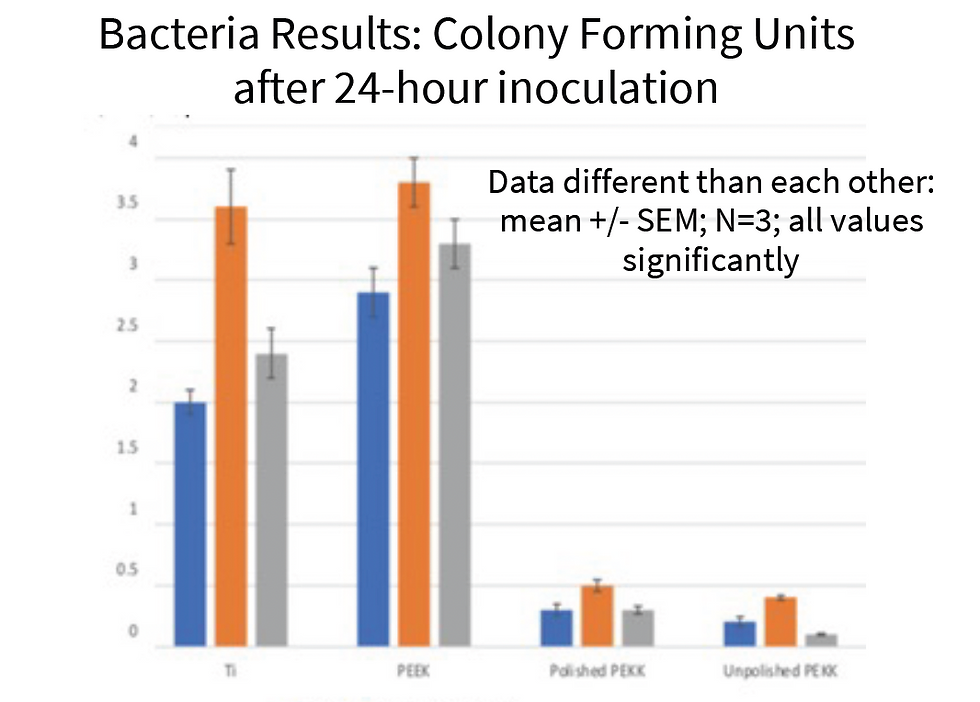
Emerging data has shown reduced colonisation of antibiotic-resistant bacteria on PEKK surfaces compared with materials such as titanium and traditional PEEK.
PEKK vs Traditional Metal Implants
Metal implants remain extremely effective, but they also introduce recognised challenges:
• stress shielding,
• imaging artefact,
• corrosion,
• ion release,
• and stiffness mismatch.
PEKK offers several fundamentally different characteristics.
Radiolucency
Unlike metal, PEKK is radiolucent, allowing:
• clearer postoperative imaging,
• reduced scatter,
• improved assessment of healing,
• and easier surveillance in oncology cases.
Bone-Like Mechanics

PEKK demonstrates mechanical behaviour closer to cortical bone than titanium alloys, potentially reducing stress shielding and improving physiologic load transfer.
Corrosion-Free
Unlike metallic implants, PEKK:
• does not corrode,
• does not release metal ions,
• and avoids concerns around metallosis or metal sensitivity.
PEKK vs PEEK
Although often grouped together, PEKK and PEEK are not the same material.
PEKK demonstrates:
• superior compressive strength,
• improved thermal behaviour,
• enhanced additive manufacturing capability,
• and different surface interaction properties.
Its engineered surface characteristics appear to support:
• improved protein adsorption,
• enhanced osseointegration,
• and reduced bacterial colonisation.
Why Upper Limb Surgeons Are Interested
Upper limb surgery presents unique challenges:
• small implants,
• thin soft tissue envelopes,
• demanding biomechanics,
• and difficult revision environments.
PEKK is now being explored across:
• ulnar head replacement,
• wrist reconstruction,
• MCP implants,
• oncology,
• and patient-specific extremity reconstruction.
The combination of:
• lightweight design,
• imaging compatibility,
• customizable manufacturing,
• and biologically favourable surface properties
is opening entirely new conversations around implant strategy.
A Shift in Orthopaedic Thinking
The future of orthopaedics may not belong to a single material. But the direction of travel is becoming increasingly clear.
Implant design is moving beyond simple strength and fixation toward:
• biologic interaction,
• microbiology,
• personalized anatomy,
• digital planning,
• and intelligent biomaterials.
PEKK sits directly within that evolution.
No metal.
No compromise.


Comments